
Angelo Home luxury chandelier
A chandelier is a attractive ceiling-mounted light fixture. Chandeliers are ornate often, and normally use lamps. Crystal chandeliers have significantly more or less intricate arrays of crystal prisms to light up a available room with refracted light. Chandeliers are found in hallways often, living rooms, and recently in bathrooms.
The indicated term chandelier was first known in the English dialect in the 1736, borrowed from the Old France word chandelier, which comes from the Latin candelabrum.
The earliest candlestick chandeliers were used by the prosperous in middle ages times, this type of chandelier could be relocated to different rooms. From 15th century, more technical varieties of chandeliers, predicated on diamond ring or crown designs, became popular attractive features in homes and palaces of nobility, clergy and merchants. Its high cost made the chandelier a symbol of luxury and status.
By the early 18th century, ornate solid ormolu forms with long, curved biceps and triceps and many candle lights were in the homes of several in the growing merchant class. Neoclassical motifs became an increasingly common element, in ensemble metals but also in carved and gilded wood typically. Chandeliers made in this style drew heavily on the aesthetic of ancient Greece and Rome also, incorporating clean lines, classical proportions and mythological creatures. Advancements in glassmaking allowed cheaper production of lead crystal later, the light scattering properties of which made it a favorite addition to the proper execution quickly, leading to the crystal chandelier.
During the 18th century glass chandeliers were produced by Bohemiens and Venetian glassmakers who were both experts in the art work of earning chandeliers. Bohemian style was basically successful across European countries and its own biggest pull was the opportunity to obtain magnificent light refraction scheduled to facets and bevels of crystal prisms. As a a reaction to this new tastes Italian glass factories in Murano created new types of creative light sources. Since Murano wine glass was not well suited for faceting, typical work understood at the right amount of time in other countries where crystal was used, venetian glassmakers relied upon the unique features of their wine glass. Typical features of a Murano chandelier will be the intricate arabeques of leaves, fruits and plants that might be enriched by colored glass, made possible by the precise type of glass used in Murano. This a glass they caused was so unique, as it was soda glass (famed because of its outstanding lightness) and was a complete compare to all different types of glass stated in the world in those days. An incredible amount of skill and time was required to twist and condition a chandelier precisely. This new type of chandelier was called "ciocca" literally bouquet of flowers, for the characteristic decorations of glazed polychrome flowers. The most sumptuous of these consisted of a metal frame protected with small elements in blown glass, transparent or colored, with adornments of flowers, leaves and fruits, while simpler model possessed arms made out of a unique little bit of glass. Their condition was encouraged by a genuine architectural concept: the area on the inside is remaining almost clear since adornments are spread all around the central support, distanced from it by the distance of the forearms. Among the common use of the huge Murano Chandeliers was the inside lamps of theatres and rooms in important palaces.
In the middle-19th hundred years, as gas light caught on, branched roof fixtures called gasoliers (a portmanteau of gas and chandelier) were produced, and many candle chandeliers were altered. Because of the 1890s, with the looks of electric light, some chandeliers used both gas and electricity. As distribution of electricity widened, and supplies became dependable, electric-only chandeliers became standard. Another portmanteau expression, electrolier, was formed for these, but nowadays they can be most commonly called chandeliers. Some are fitted with bulbs shaped to imitate candle flames, for example those shown below in Epsom and Chatsworth, or with bulbs containing a shimmering gas discharge.
The world's greatest English Goblet chandelier,(Hancock Rixon & Dunt and probably F. & C. Osler) is found in the Dolmabah?e Palace in Istanbul. It includes 750 lamps and weighs 4.5 tons. Dolmabah?e has the greatest collection of British and Baccarat crystal chandeliers in the world, and one of the fantastic staircases has balusters of Baccarat crystal.
More intricate and sophisticated chandeliers stayed developed throughout the 18th and 19th generations, but the widespread benefits of gas and electricity possessed devalued the chandelier's charm as a status symbol.
Toward the end of the 20th hundred years, chandeliers were often used as attractive focal points for rooms, and did not illuminate often.
Carondelet 6light Antique Brushed Nickel Chandelier 17074105
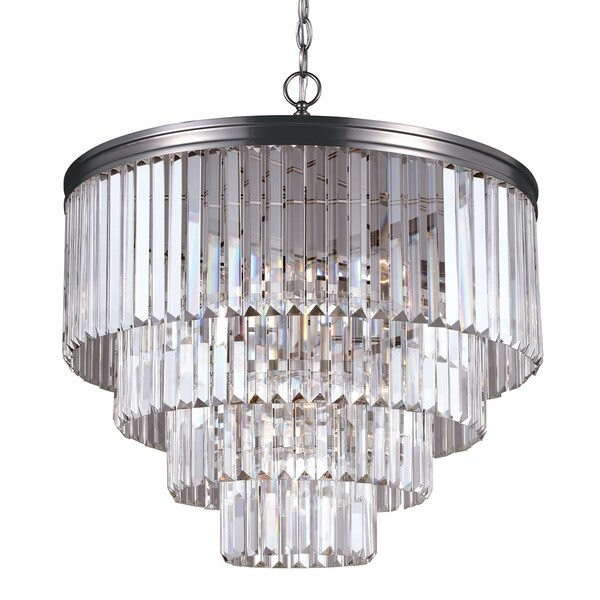 https://ak1.ostkcdn.com/images/products/9916614/Carondelet-Six-Light-Chandelier-in-Antique-Brushed-Nickel-with-Prismatic-Glass-Crystal-16ec9910-8ccf-4fdb-81cd-b54aaa696c1a_600.jpg
Justina 5light Antique Black 3tier Chandelier with Crystal Glass
 http://ak1.ostkcdn.com/images/products/9237712/Justina-Antique-Bronze-3-tier-Chandelier-with-Crystal-Glass-Prisms-4f46d8a7-19ba-4a3e-b89c-d03e6f304701_600.jpg
angelo:HOME Abbey Wingback Bed by ANGELOHOME Beds, Home and Products
 https://s-media-cache-ak0.pinimg.com/564x/09/47/8f/09478f953ffa085e6bf22e18d3f9844c.jpg
For further information, please contact the main showroom on 020 8421
 http://chaplins.co.uk/wp-content/uploads/2016/05/pininfarina-reflex-angelo-segno-08-chaplins-furniture.jpg
OIP.Mc27b550a607f99cfee1b160a9738b829o0
26B68782725147FBDBC283EDDD652808B4A130064http://overstock.com/home-garden/dangelo-12-light-round-fringe-clear-crystal-chandelier/10219887/product.html?refccid=ek76o7g7ctp2xzcdlwflwn5ksa&searchidx=965
Embed Our image to your website
ThumbnailImageEmbed Our image to a Forum
ThumbnailImage


